
The question I’m asked most
“What should I do when my dog runs off after a rabbit, or another dog?” It’s the question I’m asked more than almost any other, and it usually comes from someone who’s had a frightening or embarrassing walk and wants it never to happen again.
The honest answer is kind, but it might not be what you expect. By the time your dog is running off, the moment for teaching has passed. A reliable recall isn’t something you pull out in an emergency. It’s something you build, quietly, long before you need it.
Susan Garrett puts it beautifully: a recall is a reflection of the relationship you have with your dog. That’s good news, because relationships can be built, a little every day.
Why recall can’t be taught in the moment
When your dog is mid-chase, his brain is in a very different state from when he’s calm at home. Adrenaline is up, instinct has taken over, and his ability to listen and learn is at its lowest. That isn’t disobedience. It’s biology.
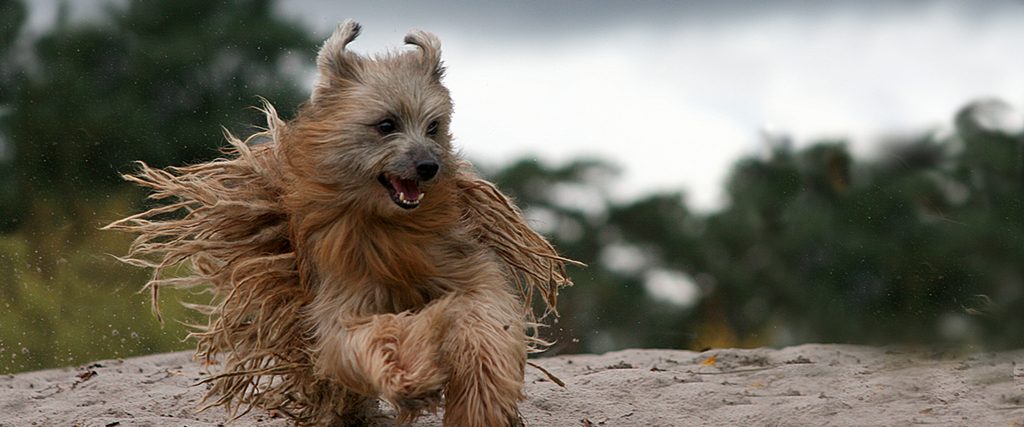
So calling in that moment is setting both of you up to fail. He doesn’t respond, you call again, louder and more anxious, and still nothing. You end up frustrated, he learns that the recall word can be safely ignored, and the next attempt starts from a weaker place.
Failure is far too easy to rehearse here, and every rehearsal makes the next one more likely. That’s why the real work has to happen before the rabbit ever appears.
Break it into small pieces
We tend to think of recall as one behaviour: call, dog comes back. But it’s really a chain of smaller skills, and each one can be taught and strengthened on its own.
- Turning towards you when he hears his name or cue.
- Moving towards you with enthusiasm, not a slow wander.
- Coming all the way in, close enough to touch, rather than hovering just out of reach.
- Staying with you until you release him
- Being released, often back to whatever he was enjoying.
If one link in the chain is weak, the whole recall is weak. Practising each piece separately makes every link stronger, and it’s far easier for your dog to succeed at one small thing than at the whole thing at once.
Make coming back predictable
Think about recall from your dog’s side. If the only time he’s called back is when the lead goes on and the fun ends, then coming to you is a gamble. Will this be the time he loses his freedom? It makes perfect sense for him to hesitate, or to decide the gamble isn’t worth it.
A predictable routine takes the guesswork away. Most of the time, coming back should mean something good happens and then he’s free to go again. The lead going on becomes just one occasional part of a pattern that’s overwhelmingly positive.
When coming back reliably pays and rarely costs, your dog can relax about it. That’s when recall stops feeling like a negotiation.
Generalising and proofing
Recall, more than almost any other behaviour, needs both generalising and proofing. They sound alike, and they’re related, but they happen at different points in training.
Generalising comes first. Dogs don’t automatically transfer what they’ve learned from one place to another. A recall that’s perfect in the kitchen is, to your dog, a kitchen recall. Generalising means practising the same skill in lots of different places, at different times and with different people, until he understands that it means the same thing everywhere.
Proofing comes later. Once he understands recall in many settings, you gradually add challenge: more distance, a little more going on around him, a mild distraction he can still turn away from. Each step is small enough that he’s likely to succeed.
Skip either stage and the recall has gaps. Those gaps tend to show up at exactly the moment you need it most.
Thirty to sixty seconds a day
None of this needs long training sessions. Intentionally spending thirty to sixty seconds a day on one small piece of recall is enough to make a real difference over time: a name turn in the garden, a few enthusiastic run-ins in the hallway, a recall and release on a quiet walk.
Each of those tiny sessions is building value in you. Not a value that only exists when there’s nothing else going on, but one that grows steadily until coming back to you is simply what your dog wants to do. Given time and consistency, that value can outpace a squirrel any day of the week.
So don’t wait until you’ve been left standing in a field. Start small, start today, and let the recall grow alongside your relationship.