
When care points in the wrong direction
You’ve just come back from a good long walk. You’ve barely got your coat off, and your dog is tearing round the living room, bouncing off the sofa, spinning in circles. It’s easy to think: she can’t have had enough. She needs more.
That thought comes from a good place. You want your dog to be happy and fulfilled, and you’re willing to put in the miles to make that happen. That’s care, and it deserves to be recognised.
But zoomies don’t always mean what they look like. Very often, the answer isn’t more. It’s less.
What zoomies often really mean
Sometimes a burst of zoomies is simply joy, a happy release after a bath or a game. There’s nothing wrong with that. But when zoomies show up as a pattern, especially straight after walks or late in the evening, they’re often telling us something else.
After a walk, it’s often overstimulation. A walk is full of sights, sounds, smells, other dogs and people. All of that input has to go somewhere, and when your dog gets home, it can come pouring out as frantic running. That isn’t energy left over. It’s too much taken in.
At the end of the day, it’s often overtiredness. Much like a toddler who gets louder and wilder the more tired they are, an exhausted dog can struggle to settle. The zoomies aren’t a sign she wants to keep going. They’re a sign she’s past the point of being able to switch off on her own.
Why more exercise can make it worse
If zoomies are a sign of too much stimulation, then adding more stimulation feeds the very thing we’re trying to calm. Another walk, a longer game of fetch or a run in the park can leave your dog even more wound up, and the zoomies come back stronger. It’s easy for both of you to get caught in that cycle without realising.
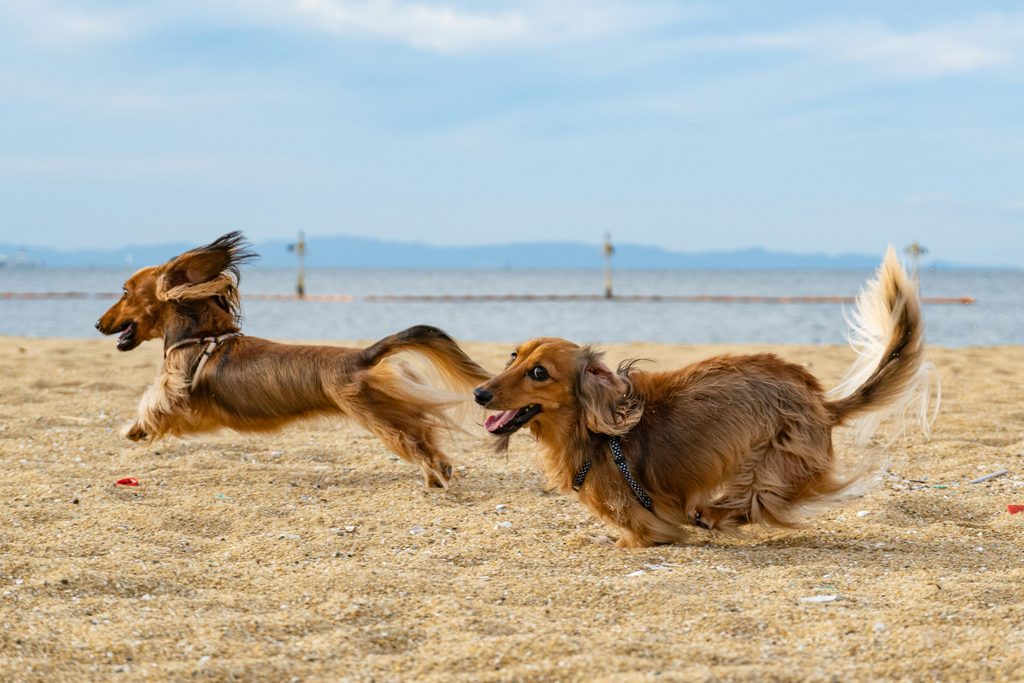
There’s a physical side too, particularly for puppies and young dogs. Their bodies are still growing, and a lot of repetitive, high-impact exercise can put strain on joints that aren’t finished developing. The effects may not show for years, which is exactly why it’s worth thinking about now.
In puppies, you’ll often see the same overload show up as mouthing. A puppy who’s nipping and grabbing and won’t stop is frequently a tired or overstimulated puppy, not a naughty one.
Three questions to ask
Rather than reaching for a label like “hyper” or “too much energy”, it helps to pause and ask what’s really going on.
- Is she overtired? Think about how much genuine, undisturbed rest she’s had today. Adult dogs typically sleep for much of the day, and puppies need even more.
- Is she overstimulated? Consider what she’s just done or seen. A busy walk, visitors, or a lot of excitement can all tip her over.
- Could she be in pain or discomfort? Sudden running, spinning or restlessness can sometimes be a dog trying to shake off something that feels wrong, such as itching, an upset tummy or soreness. If the zoomies seem new, frantic or out of character, a check with your vet is always worth it.
The answer might be one of these, or a mix. Either way, asking the question puts you in a far better position to help than any label would.
What helps instead
If the answer is overtiredness or overstimulation, the kindest response is to help her come down, not wind her up further.
- Give her somewhere quiet to settle, away from the busiest part of the house.
- Offer calm, low-key activities such as a lick mat, a chew or a gentle scatter of food to sniff out. Licking, chewing and sniffing all help dogs relax.
- Keep your own energy low. Soft voice, slow movements, no chasing or rough play.
- Look at the bigger picture. If zoomies are happening most days, it may be worth building more rest into her routine, or making some walks calmer sniffing strolls rather than busy outings.
More isn’t always better. Sometimes the most generous thing we can give a dog is a proper chance to switch off.
Question, don’t label
This is really what the whole Canine Connection Framework comes down to. When a dog does something that puzzles us, the most useful thing we can do is ask why, rather than deciding what it means.
Zoomies are a perfect example. They look like excess energy, so the natural response is to burn it off. But once you start asking whether she’s overtired, overstimulated or uncomfortable, you’ll often find the answer is rest, not another lap of the park.
You were never doing it wrong. You were doing your best with the information you had. Now you’ve got a better question to ask.
Photo by Kojirou Sasaki on Unsplash